

Finding Identity and Belonging through Designed Objects and Spaces
Tapiwa Matsinde
Tapiwa is the author of several books including Contemporary Design Africa, the first art book to showcase and survey a generation of innovative designers from across the African continent and beyond. Tapiwa’s podcast Behind The Design introduces conversations with some of Africa’s exciting designers
In early Autumn 2021, luxury product designer Ini Archibong unveiled The Pavilion of the African Diaspora (PoAD) at the London Design Biennale. Designed to mimic the curves of partially submerged conch and cowrie shells, the pavilion’s canopy-like structure was both symbolic and practical, conceived as “a sanctuary for people born of the African Diaspora to tell their stories.” Archibong, born to Nigerian parents in America and now based in Switzerland, intended the PoAD both as a public marker of the presence of a community that has needed to establish roots in foreign lands, and of the fact that for members of this community or their descendants, those lands are now home. In addition it was a reminder that for this diverse group of African diasporic subjects, life in their new homes is fraught with complex challenges.
The Pavilion of the African Diaspora (PoAD) at the London Design Biennale. Image Copyright © Ed Reeve and the London Design Biennale
To be of African heritage yet non-African in nationality—for example, European, American, Caribbean, Indian or Australian—involves navigating a tightrope between identity and belonging in the place one has chosen (or been forced) to call home. The situation of the Siddi, one of the most marginalised African diasporic communities, acutely illustrates this. Mainly as a consequence of slavery, the Siddi arrived in the Indian subcontinent via the East African coast as early as the 7th century. They have long struggled with levels of discrimination that made assimilation into the wider society impossible. Tending to self-isolate, they have held onto various Bantu African traditions, passing them down through collective memory and forging an Afro-Indian cultural identity. Handed down through families, their vibrant, one-of-a-kind quilts—mosaics of fabric scraps and embroidered motifs that tell their stories—beautifully express this.
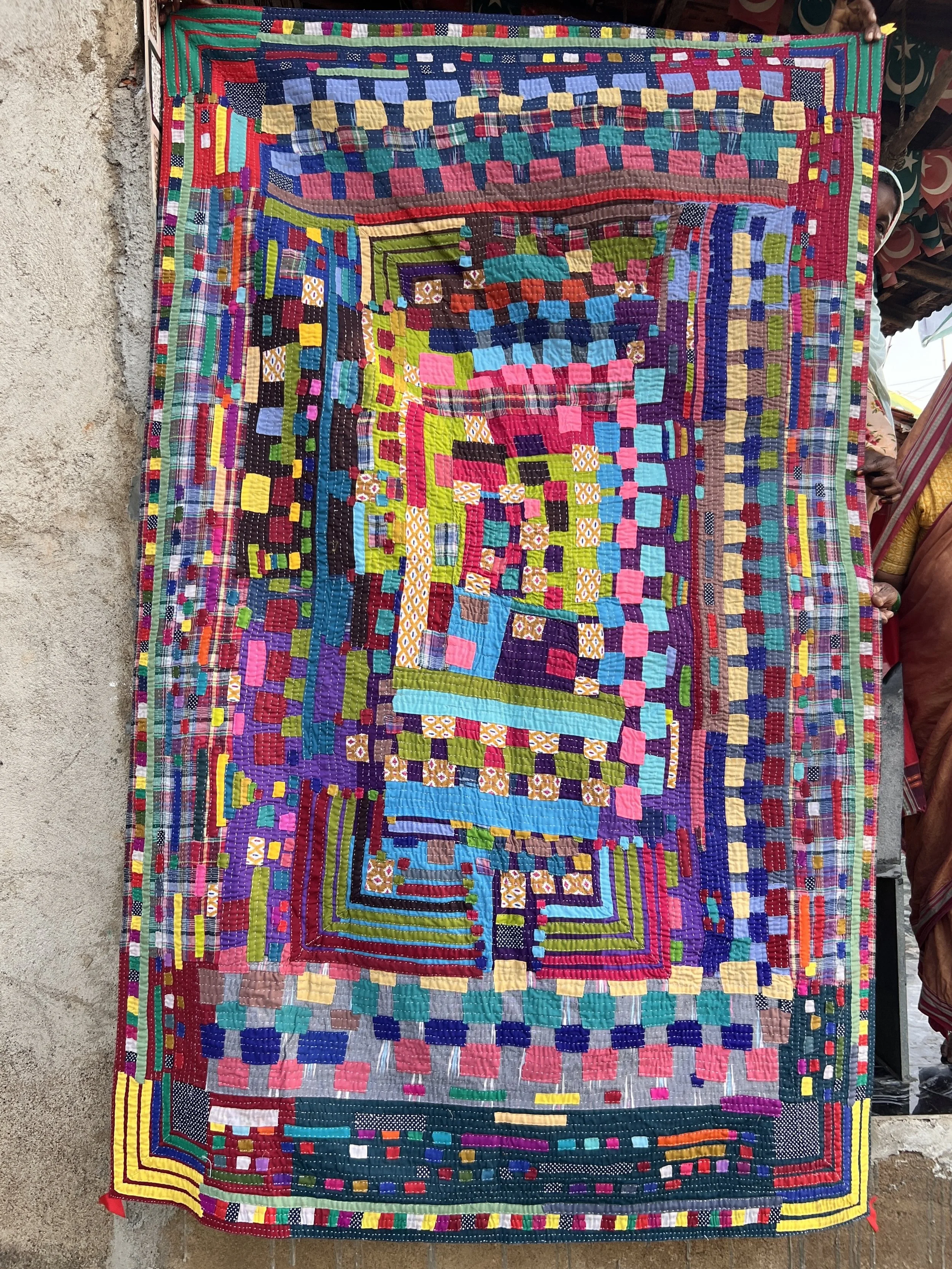
Quilt crafted by Siddi women artisans in Karnataka in collaboration with art historian, curator, and community-based textile art practitioner, Anitha Reddy.
Communities across the diaspora pass on cultural traditions or inherited memories and tell their own stories of identity and belonging in similar ways. While some traditions, memories and cultural origin stories have disappeared over time, the fragments that have survived have done so by being part of an individual, family or community’s habitual way of doing things. Creativity is one of the most powerful methods by which narratives around culture, community, identity and belonging are expressed, preserved and revitalised. Designers, for example, channel their diasporic cultures by grafting inherited aesthetic forms and motifs into functional and decorative objects, artefacts that enable users to connect with their roots in both personal and public spaces. Design enables diaspora’s subjects to express affinity and engagement with aspects of a culture they may be removed from, yet still feel connected to.
Brooklyn-based design studio AphroChic’s “Diasporic Modern” aesthetic exemplifies this. Its range of goods deliberately suggest African diasporic culture, history and experience: founders Jeanine Hays and Bryan Mason endow some of their designs with patterns, textures and forms inspired by the arts and crafts of the African continent. In the United Kingdom, designer Mac Collins blends aesthetic and craft influences from his African-Jamaican and British heritages. His commanding Iklwa chair, with its shield-shaped back and spear-like arms, symbolises strength and resilience. The design, he says, is “a direct response to the forced migration of African people during the colonial era, offering a seat to those who would have felt powerless after continuous oppression” [1]. The chair enables the user to establish their presence within the environment they are in.
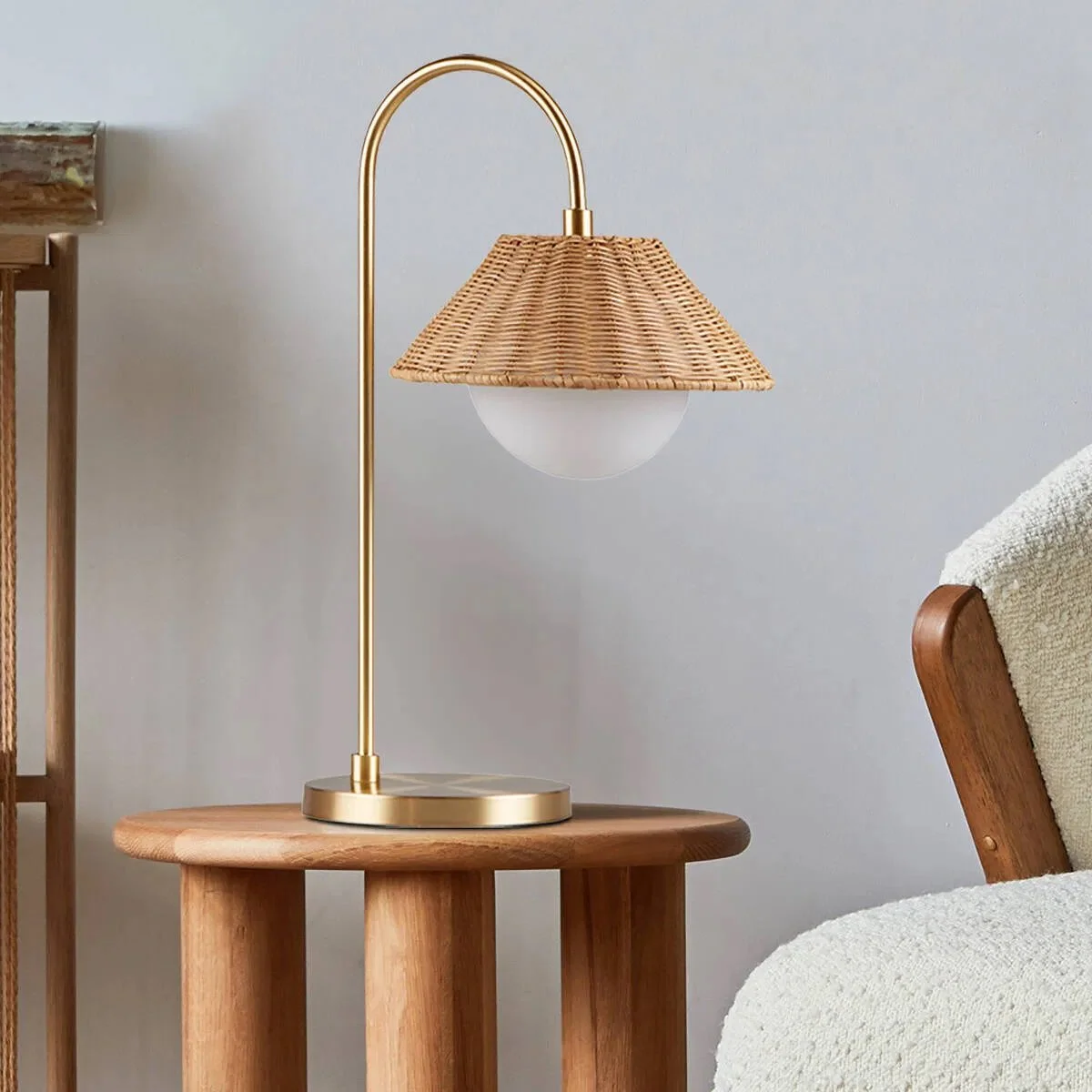
AphroChic Mende Lamp - Image Copyright © AphroChic
Designers such as Hays, Mason and Collins celebrate heritage influences and connect creators, users, and critics to diasporic stories, creating objects that contribute to the collective, global advancement of African design in all its diverse expressions. However, acceptance as a full member of the collective is not always a given. Even as they face challenges of identity and belonging in the places they call home, diasporic creatives often encounter scrutiny when engaging with Africa itself. The African continent, revered as the “Motherland”, may feel like home, irrespective of whether one has existing familial ties with it or been born, resident or a visitor there. Nevertheless, diasporans may struggle to find acceptance and belonging among those who believe themselves to be authentically “African”, with everything that is perceived to imply, and may find themselves having to contend with soul-piercing statements from fellow and non-Africans alike that challenge the validity of their Africanness, and the ways they choose to express it.
Kenyan fashion curator, creative director and filmmaker Sunny Dolat addressed this tension in his 2018 essay Not African Enough. His critique of aesthetic gatekeeping in African fashion by both Africans and non-Africans extends beyond issues of dress to consider the criteria for “Africanness” that are applied in diasporic creative work, probing questions such as, “What is African design? Who defines it?” or “What qualifies diasporic aesthetics as “African?”. As a term, “African design” has some use for classification, but it fails to capture Africa’s myriad cultural materiality and traditions, and it has historically had associations with harmful stereotypes. At times its use is necessary, but “African design”, and “African designer” inevitably mean different things to different people. Some embrace the terms, others don’t, and interestingly, this often depends on where a designer is based. Designers on the Continent are more likely to term their work “African”, while diasporic designers, in contrast, may reject the label, not to deny their heritage but to avoid being constrained by restrictive expectations. Indeed, the Continent’s designers may also find themselves contending with shifts in the perception and interpretation of the term as they navigate global platforms.
It is also worth noting that designers on the Continent are more likely to identify themselves by their nationality—Ghanaian, Kenyan, Zimbabwean, and so on, and in doing so they affirm the sense of rooted identity that diasporic designers are often on a journey to discover. Diasporic designers’ local environments will undoubtedly have an influence on their creative identities, but they may or may not seek a connection to their African roots, and neither approach diminishes their identity. Creativity remains a personal expression for them, so the idea that there exists a single “diasporic aesthetic” is arguably a mistake.
No matter how far removed from it they may be, designers who do choose to explore their African heritage make work that invites its users to reflect, reconnect with their sense of roots and celebrate their culture. The influence of African traditions can play out deliberately or subconsciously, and be revealed through forms, patterns and colours that are deeply rooted in memory. The work of fellow contributor to this Presents issue Jomo Tariku exemplifies an entirely overt address to African art and design history. Born in Kenya, raised in Ethiopia and now living in the U.S., Tariku’s contemporary furniture reimagines classical African objects such as Dogon stools, hair piks and birthing chairs. His pieces have been collected by the Museum of Modern Art, New York, featured on the set of the 2018 film Black Panther and graced the home of former US Vice President Kamala Harris. When Tariku and other African and diasporic designers have work installed in this kind of high profile context, the agendas of diasporic design are brought into the global conversation. The presence of diasporic subjects and their integral role in shaping their societies is placed on record, and the cultural past, in which objects were taken and displayed without explanation of their authorship, origin or significance, is called to account.
Despite the challenges, when opportunities are created for Continental and diasporan creatives to exhibit, dialogue and work together, important conversations about the perspectival diversity of the African experience, and the evolution of traditions through migration, are sparked. A notable example is a 2022 project by The Africa Centre in London, in which the centre reconfigured its headquarters through an African-led architectural and interior design lens, commissioning and displaying contemporary furniture and decor by designers and artisans from both the Continent and the diaspora. A highlight of this was a sofa that fused diasporic and Continent-based craftsmanship. It featured fabric designed in the UK by British-Ghanaian textile designer Chrissa Amuah using the Adinkra symbols of her Ghanaian heritage, which was then realised in Senegal by textile designer and furniture workshop owner Aissa Dione as upholstery for a handcrafted sofa. The finished piece was installed alongside other works by African heritage designers and artisans, symbolising unity in diversity, and the practice of finding belonging wherever one is located. More than just a functional object, the sofa became a focal point—a space for conversation, reflection, and comfort in an environment that upholds The Africa Centre’s enduring byline ‘A Home Away From Home’ for Africans in the UK [2].
The Africa Centre - Sofa - Image Copyright © Tapiwa Matsinde
Installations such as this, or the Pavilion of African Design; debates, cultural festivals, literature, and exhibitions of design, craft, architecture, art, film and fashion, all help reveal how the African diasporic community makes its creative mark in its respective societies. The experience of diasporic designers, continually pushing against barriers that seek to homogenise their diverse creative expressions under the banner of ‘African’, is both individual and collective. In an ideal world, they should have to worry less about how they choose to express their heritage and culture, and more emphasis should be placed on the impact their practices have in fostering a positive sense of identity and belonging—in both the public, and the personal, environments of those who engage with their work.
Notes
[1] https://www.holeandcorner.com/news/mac-collins
[2] https://www.africacentre.org.uk/blog/the-making-of-home
References
https://londondesignbiennale.com/pavilions/2021/african-diaspora
https://minorityrights.org/communities/siddi/
https://www.holeandcorner.com/news/mac-collins
https://www.businessoffashion.com/articles/news-analysis/op-ed-not-african-enough/

