

Alone, Together, Like Beads on a String (2022-)
Rafiki
Part memoir, part material inquiry, this text considers identity and belonging through language, dress and shared histories. Drawing on Central African philosophies and lived experience across geographies, it frames culture as relational, in motion and held together through collective meaning-making rather than fixed tradition.
Rafiki is an artist and curator based in Oslo. Rafiki’s interdisciplinary artworks move between photography and bead work, textiles and text, and the use of memorial objects old and new. Rather than producing finished products as an end result, Rafiki treats art-making as a practice of remembrance, healing, and cultural analysis.
Her images often employ artistic strategies that avert a western anthropological gaze. Incorporating symbolisms, fables, and tools of visual storytelling and oral history, she invokes themes of forced migration and war ghosts, racialized perceptions of Blackness and femininity, and fraught colonial traditions of spatial power and temporal erasure. As a child of the Congolese diaspora with local connections in various countries in Africa and Europe, she taps into pre-colonial forms of global interconnectedness and knowledge transfer.
Rafiki is the founder of Oslo-based platform Rafiki Art Initiatives (RAI).
“Everything is everything, what is meant to be will be”
— Lauryn Hill, Everything is Everything
Growing up in rural Norway in the early 2000s challenged my musical and artistic values. Kids around me were hypnotised by the sounds of U.S. bubble-gum pop stars like Britney Spears and Christina Aguilera, or the electrifying vibes of EDM and its galaxy of stars—Dabuzz, Bomfunk MCs, E-type, Aqua and more—or the minimal and muted tones of Scandicool. Sonically and aesthetically, these sound worlds seemed a million miles away from the palettes I had grown up with in metropolitan central Africa, from the Congolese Ndombolo and Tanzanian Bongo Flava of my childhood cassettes, CDs and MP3 players.
Maybe that’s why Lauryn Hill’s 1998 debut album The Miseducation of Lauryn Hill hit me so hard. In it I found reminiscences of things learned long ago. Not only did she have beautiful, flawless, dark chocolate skin that looked like mine, something I didn’t see represented around me at that time. She was also an amazing, multihyphenate artist who said things that made sense to me beyond her music. The words and messages of Everything is Everything loudly echoed the struggles I had undergone from an early age, the social values I had learned and memorised, and survival mechanisms I had cultivated.
Hill was famous and beautiful but she didn't limit her creativity to a singular expression of an artistic “me”. She wrote honest and poignant prose that exposed her vulnerability and strength—as a human being, a young Black woman, an artist who happened to be female, and an aspiring mother. Her album canonised the story of a powerful woman in full bloom, and she dedicated its passionate hit song to “the mothers, the fathers, the brothers, the sisters...the regulars”. I felt I could be one of them. Her work didn’t just entertain, it also taught and gave strength to its listeners, in a way I didn’t realise I needed at the time. I was not at all surprised when, in 2024, her album topped Apple Music’s “best of all time” list.
Hang in with me as I explain this (de)tour into my millennial teenage playlists: there’s a lot to unpack. Let’s start with the song title Everything Is Everything. This sounds like the proverbs and riddles that I grew up hearing from my elders. It’s almost impossible to have a full conversation with an African elder in their mother tongue or another local language without being served at least one of these. More and more, I have realised that Central African languages in particular aren't just systems of grammar and vocabulary. They build on psychological and philosophical concepts that are immaterial and yet deeply tangible, visual and metaphorical. The older generations rarely speak in purely literal terms. Instead, they conjure up mental pictures that convey meaning beyond the words themselves.
One cherished utterance from my upbringing is the plea to remember that we are all like “goats tied on the same rope”. An uninitiated ear might visualise this image literally, as a scene of animals grazing, or even a surreal picture of humans tethered like goats in a field, but its deep meaning goes beyond zoomorphic depiction and calls for a shared (de)construction. Each of these proverbial goats is individually tied to a common rope and although they each feed independently, their movements affect one other. Their freedom is limited not only by each other but also, it is implied, by the strength of the tree that anchors the rope. The image is a metaphor for our shared existence: we are individually autonomous and yet deeply interconnected.
This elementary example helps us understand how the act of holding a conversation in a Central African language works through negotiation rather than transmission. In addition, though, we need to note that speaking as a form of negotiation is done on the premise that in the absence of shared points of reference, those who converse will be willing to learn each other's reference points and express their own in a similar way. This is different from the western notion of universalism; it does not blindly assume that we all have a shared understanding. It makes it clear that every exchange calls for interpretation, imagination and immaterial labour based on one's own position in the exchange. The listener is never passive: they’re actively engaged in making sense of what’s said before they (re)assume the role of speaker. Communication through language becomes less about clear-cut messages or positioning within a binary structure of sender and receiver, it becomes a much more collaborative act of meaning-making.
I am local to both the central region of the African continent and the northern European region of Scandinavia. I also navigate between rural and urban settings. The dominant political, economic and even historical perspectives of our time might make these seem, literally and figuratively, like two pairs of polar opposites, but for me, they are united into one position of Being, one mode of existence, by the concept of “home”. I am not divided, I am whole, no matter which geographical location I find myself in. My artistic explorations are a material manifestation of the immaterial values within me and beyond me, and the work I do often weaves the elements of my biography together, within and against wider political and postcolonial contexts.
These ideas help introduce and summarise the themes I will invoke in my contribution to the Norwegian National Museum’s touring exhibition Skakke Folkedrakter (Queer Folk Dress). When invited to participate I decided to engage with the notions of “seeing”, Being, and carrying the immaterial, through tangible vessels of communication such as textiles. As I’ve shown, speaking is more than transmitting. It also involves "seeing" the visual images that are invoked in a conversation. My contribution to the project asks, “if you consider this work as a conversation between me and you, what do you see”?
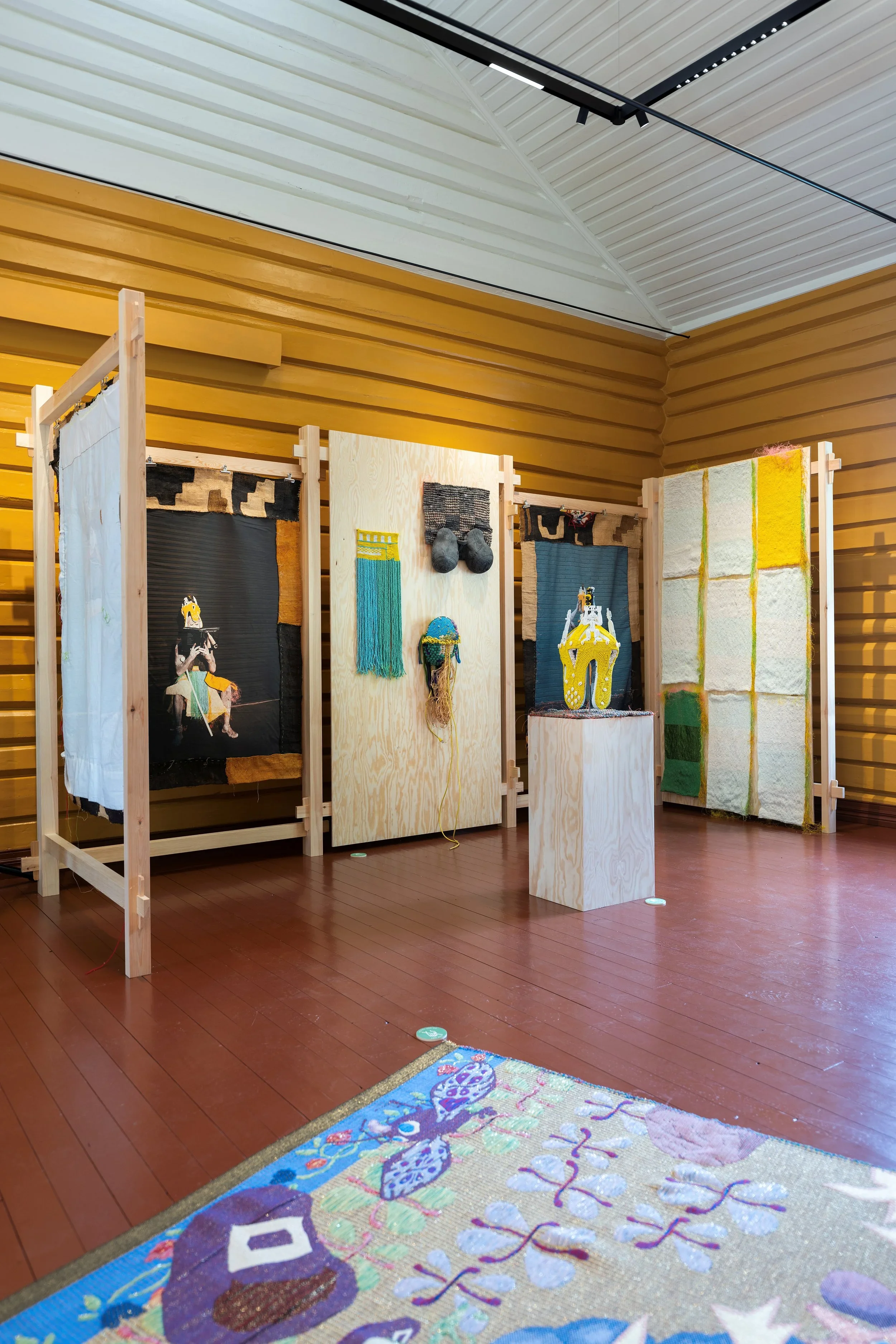
Rafiki – Alone, Together, Like Beads on a String in the exhibition Skakke Folkedrakter [Queer Folk Dress] at Valdres folkemuseum. Photo: Andreas Harvik
The work is expansive and employs materials such as wood, glass and ceramic beads, textiles and photography: elements that are evident and very recognisable. My choice of carefully woven, detailed beadwork serves to start conversations about both who we are as individuals, and how we function as a society. During field studies in Sápmi and multiple Norwegian folk costume forums I quickly learned that folk costumes in these regions are highly locally specific. One group from one place wears and “owns” a certain style, pattern or look to which a certain value is attached. Something that might be read abstractly as an aesthetic value—a specific colour or shape—in fact exists within Sámi traditions as a context-dependent marker of age, kinship and territorial belonging. The same goes for Norwegian folk costumes, but these are also historically tied to nationalist values.
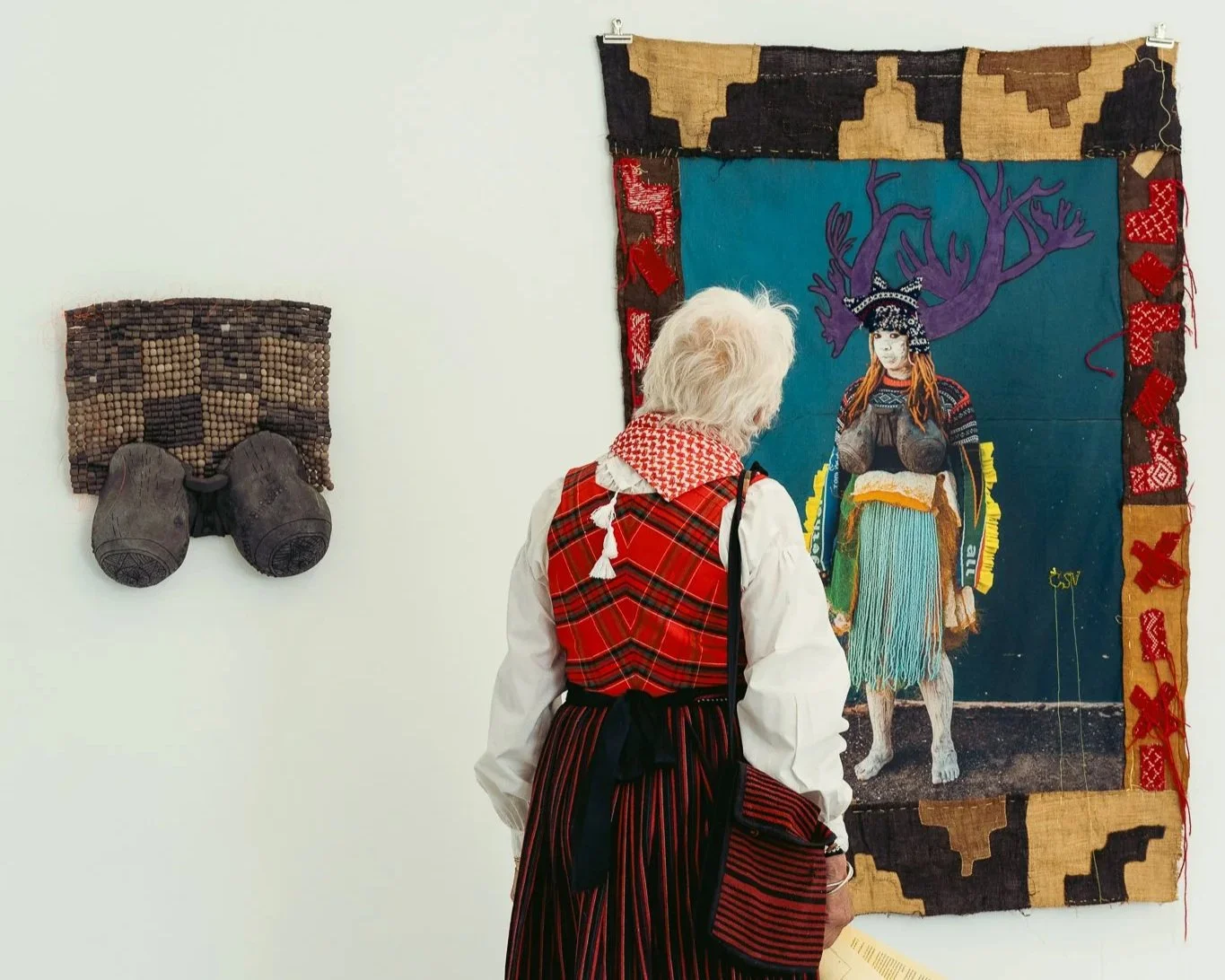
Rafiki – Alone, Together, Like Beads on a String in the exhibition Skakke Folkedrakter [Queer Folk Dress] at Hordaland Kunstsenter. Photo: Hordaland Kunstsenter
During my studies I also noticed that Sámi folk costumes, although very restrictive with regards to ownership, are a living tradition in which innovation and personal preferences are more welcome than with the Norwegian folk costume tradition. Learning from the allegory of the goats mentioned earlier, the notion of individual ownership isn’t seen as neutral through the lens of ancestral philosophies. That is why my work explores the idea that identity, belonging, and expression is inherently fluid, messy, in-progress and still complete. This is my truth as a person who navigates many histories and localities at the same time.
Hence, my work deconstructs, pieces together and questions elements from the Congolese Luba culture, Sápmi, and Norway. What might require more labour from the viewer is the juxtapositions, the abstractions and the alignments. My “costume” was developed collectively across Sápmi, Oslo and Cape Town. Process is just as important as the “finished” work presented in the gallery spaces around the country. The work came together organically, drifting from place to place and using a method rooted in healing and therapeutic community growth and in everyday ritual. It brings disparate elements from opposite sides of the globe like the Norwegian Marius sweater paired with fashion-meets-pop cultural references from the 2010 FIFA World Cup (the first one ever held on the African continent, and a very controversial topic in the South African debate on social equality) on the extreme opposite part of the world. I have paired the ritual kaolin face and body paint with Converse sneakers, mixing street culture with ancestral practices to showcase the fact that heritage is a living mechanism that is not always concealed in mysticism or existing in some archaic form that is stuck in the past. The masks and beadworks paired with woven Central African raffia cloth are also a meeting that is not devoid of conflict: the raffia is an organic, home grown and locally woven fabric that is a shared cultural treasure for the multitude of ethnic groups living in Central Africa while the imported beads have a long and painful history in the region. Glass beads were introduced to Central Africa as barter and trade objects from the 15th century onwards. For centuries, beads competed with local currencies like raffia and copper. They were used by European explorers, traders, and missionaries to buy goods from communities in Central Africa.
Because they were hard to get, beads became symbols of wealth and were often worn by elites. Many local rivalries that continue to exist in these communities stem from the practices of some of these elites who were involved in exploitative trade practices. Beads were exchanged for resources that were taken at great cost to both nature and local communities. They were part of trades involving things like gold, diamonds, ivory, pangolin scales, rhino horn, palm and coconut oil. In extension of these practices, deeply unequal deals that contributed to the exploitation of people and the environment in the Central African region continue to be a part of our existence today. Similarly, important parts of my ancestral Luba traditions, just like Sámi ones, were banned, distorted, devalued or (attempted) erased during colonisation. Could human greed be the proverbial tree that restricts the grazing goat’s individual and collective freedom of movement? That one is for you and your mind only to enjoy.
Alone, Together, Like Beads on a String comments on the recognition of these kinds of intercontinental interconnectedness. Not only does it call for unity in grief, but it also points to the strength in mutual recognition and empathy across geographies. Similarly, there is another point made about these expressions going beyond whatever aesthetic values that are assigned to them in our own time. By reinventing the Bunad for instance, which takes reference from the country bourgeoisie – the farmers and land owners – as a folk tradition, one assigns an aesthetic value that belonged to a specific social class onto the entirety of a contemporary society that is quite removed from its poverty and inequality ridden past: poor people could never afford them then and they still can't in our time. How representative these cultural expressions are for Norwegians as a whole leaves plenty room for analysis.
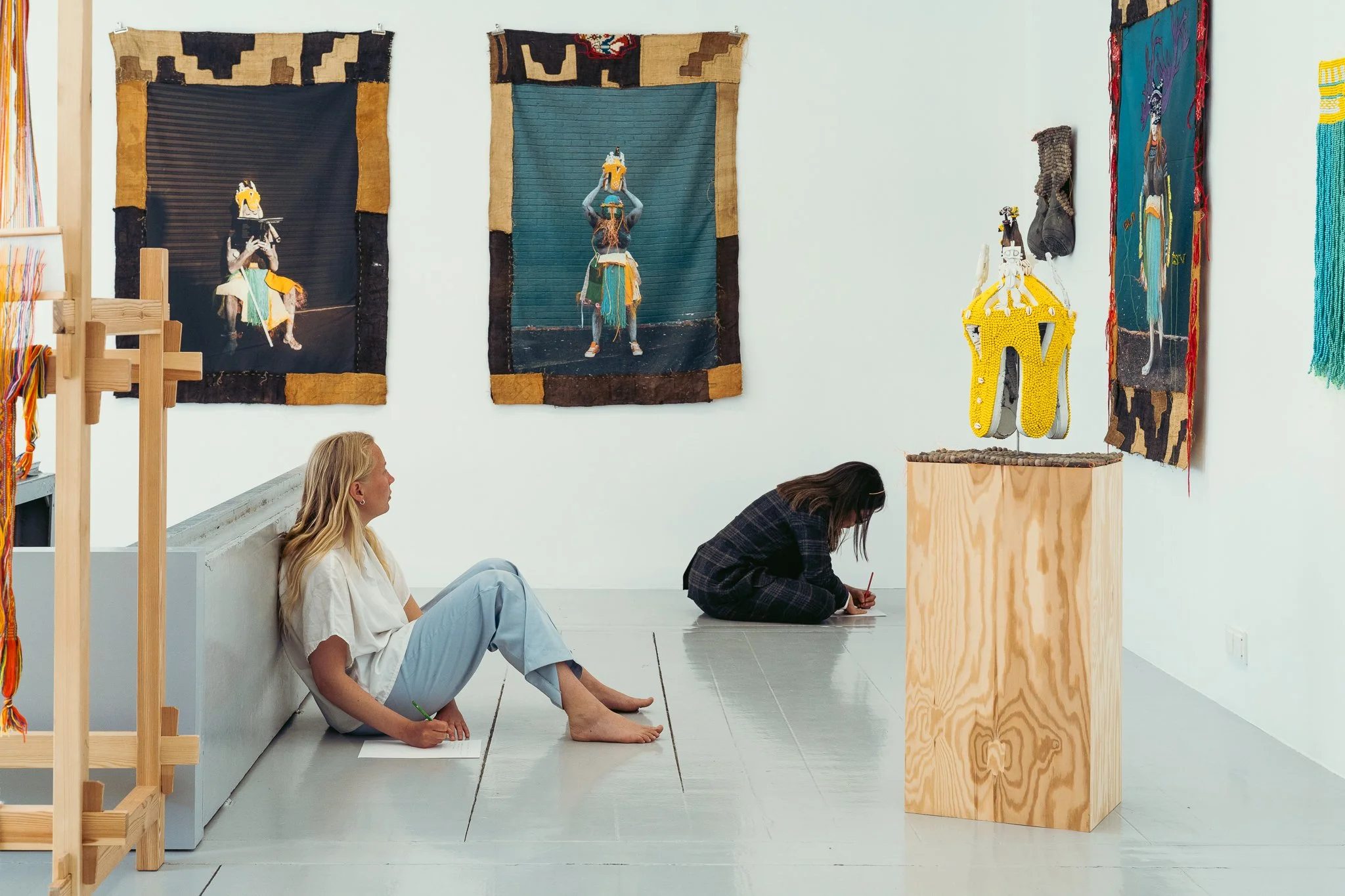
Rafiki – Alone, Together, Like Beads on a String in the exhibition Skakke Folkedrakter [Queer Folk Dress] at Hordaland Kunstsenter. Photo: Hordaland Kunstsenter
One can draw a parallel to beads that have long since been adopted into various African aesthetics, wiping away the roots of the past abuses and inequalities that are still felt and experienced all over the continent: to this day most of the beads that are sold on the African continent are imported rather than locally produced. Hence, I am not really commenting on the idea of folk costumes being an accurate sartorial representation of “a people” and their aesthetic traditions. The work insists on the importance of opening up for the reimagination of what an “I” and a “we” means or could become. It is an exploration of culture as something layered and in flux rather than something stagnant and fixed. It does not consider sartorial choices purely for their aesthetic values; it considers aesthetics as mnemonic objects, or tools with which memory is analysed, nurtured and stored. Just like our elder's figure of speech evokes deeper meaning beyond the uttered word, this work uses clothing and adornment or the lack thereof as depositories of memory; through them one remembers the migration patterns, the directions taken, the grazing fields, temporary and present dwelling places, the encounters along the way, those who made it and those who didn't, and the values embedded in our ever transforming traditions. Looking at them, some might see a Norwegian or Sámi reference. Others might see something reminiscent of the African continent. Both might be right.
It feels like a lifetime ago since Ms. Hill said it. Our ancestors knew it long before her and whoever inherits this planet long after we’re gone will be in the loop too: everything and everyone is hybrid. We are all carriers of knowledge, mixed identities and interconnected references. We brought nothing to this short-lived experience of living here, and neither will we take anything with us. We are all alone, and yet together, like beads on a string. This is a truth that doesn't need to fit into the restraining molds of academic disciplines and their less than ideal origins to be understood. Whether it’s sewn into the fibers that we carry on our bodies, in the rhythms that bring us meaning beyond the entertaining values of popular music or in the letters in this essay: Everything is everything, what is meant to be will be.

