

An anthology of art & ideas
—Issue 3 out September 2021
Eds. Rachel Withers and Nicholas J. Jones
Issue 2:
Heavy burdens, Happy burdens
—art work and history
Summer 2021
Introduced by Rachel Withers
The sky is blue, the path is dusty and dry, and the artist is striding along with his wooden staff in hand and his easel slung on his back. Seeking the warmth of the morning sun on his face, he has swept off his hat as he goes. It is swinging in his other hand as he nears his two acquaintances, who’ve been waiting for him at the bend in the road. They make a considerable show of doffing their hats in greeting. “Bonjour, Monsieur Courbet,” says the younger-looking of the two, who is conspicuously smarter and more self-possessed than his companion. “You have every indication of excellent weather for your day’s work.”
Gustave Courbet’s reply is unrecorded and indeed totally hypothetical, since the encounter represented in his famous 1853 painting The Meeting is a “real allegory” and a complex fiction. (It is also a “speechless” one, in the sense that all its personnel are shown with their mouths shut; maybe it’s this that tempts one to add one’s own dialogue). It is a work that makes various powerful truth claims through its reflexive use of allegory: for example, by positioning the artist himself within the picture’s frame, as a witness, a truth-teller and the bearer of a historical as well as a literal burden. Back in the 1960s art historian Linda Nochlin established that Courbet’s self-portrait in The Meeting reiterates nearly millennium-old iconography: he painted himself as the mythical figure of the Wandering Jew. Having sinned in some way against the living Christ, the Wandering Jew was doomed to roam the earth until the Second Coming: he is the embodiment of endless witnessing, a kind of “walking proof”. The Wandering Jew’s identity and narrative have been reinvented and reinvested ad infinitum, and for the radicals of the nineteenth century he symbolised the oppressed manual labourer, a kind of worker that Courbet manifestly was not. That complicates but does not necessarily undermine the manifesto call for freedom, independence and dignity in labour painted by Courbet into The Meeting. The man greeting the artist is his patron Alfred Bruyas, the affluent bougeois who commissioned the picture in which he appears. Courbet shoulders his backpack with conspicuous ease and responds to Bruyas, in beard-language, that the old patron-client relationship no longer applies.
Jane Blocker concludes her 2009 book Seeing Witness: Visuality and the Ethics of Testimony with the proposition that under certain circumstances, “contemporary art can productively throw into question the claims that are made on the real and at the same time maintain an ethical responsibility to reality” (p. 128); it can also help us to see, appreciate and interrogate the subject or the apparatus that sees. Courbet’s paradoxical realist allegory shows that older practices have achieved this too, and its interweaving of ancient imagery with the figure of the artist as witness and the bearer of a burden of responsibility makes it, I think, a pregnant companion and introduction to the diverse works we’ve brought together in this issue of PRAKSIS Presents.
Heavy burdens, Happy burdens probes the complexities, responsibilities and possibilities of making art works that bear witness to processes of history or memory. All the featured works use historical materials, mythological imagery or traditional narrative to address present-day issues that are both personal and global in their importance. In the process, tricky questions relating to reality, truth, identity, subjectivity and seriousness are thrown up. Each work has its own particular reflexive relationship to its historical subject, and in different ways they all ask their audience to reflect on this. In some works, the artist’s affective labour is a conscious point of focus: bearing witness can be heavy but it can also be joyful, sometimes at one and the same time. In others, distancing strategies are explored: for example, by hypothesising the potential of decentering the anthropocentric view within the representation of ecological crisis. And while reflecting on this labour and these approaches, viewers are prompted to think about their own responsibilities as fellow bearers of the burdens of history and memory.
A statement by PRAKSIS 2019 resident Syowia Kyambi was key in helping us crystallise this issue’s theme. “We carry our histories on our backs, hunched over and barely heard, constantly swimming against the stream… The body holds, codes and re-codes, sharing a multitude of layered stories… Collective history weaves a web in the memory of our contemporary bodies.” In her video essay Becoming Kaspale, the artist reflects on the emergence of Kaspale, a multifaceted, creolised avatar or performance medium through which Kyambi revisits and processes the trauma of living through Kenyan dictator Daniel arap Moi’s regime. Kaspale is a “joker”, but a very serious one; their mission is the symbolic demolition of Nyayo House, a physical embodiment of, and metaphor for, Moi’s nationalist-authoritarian ideology. As we listen to the artist’s voice, we watch her on screen; ochre, silver and gold help prepare her body for the transformation. It’s been exciting working with Kyambi on the resolution of Becoming Kaspale, and we thank her – and indeed all our contributors – for their active participation in the PRAKSIS Presents editorial process.
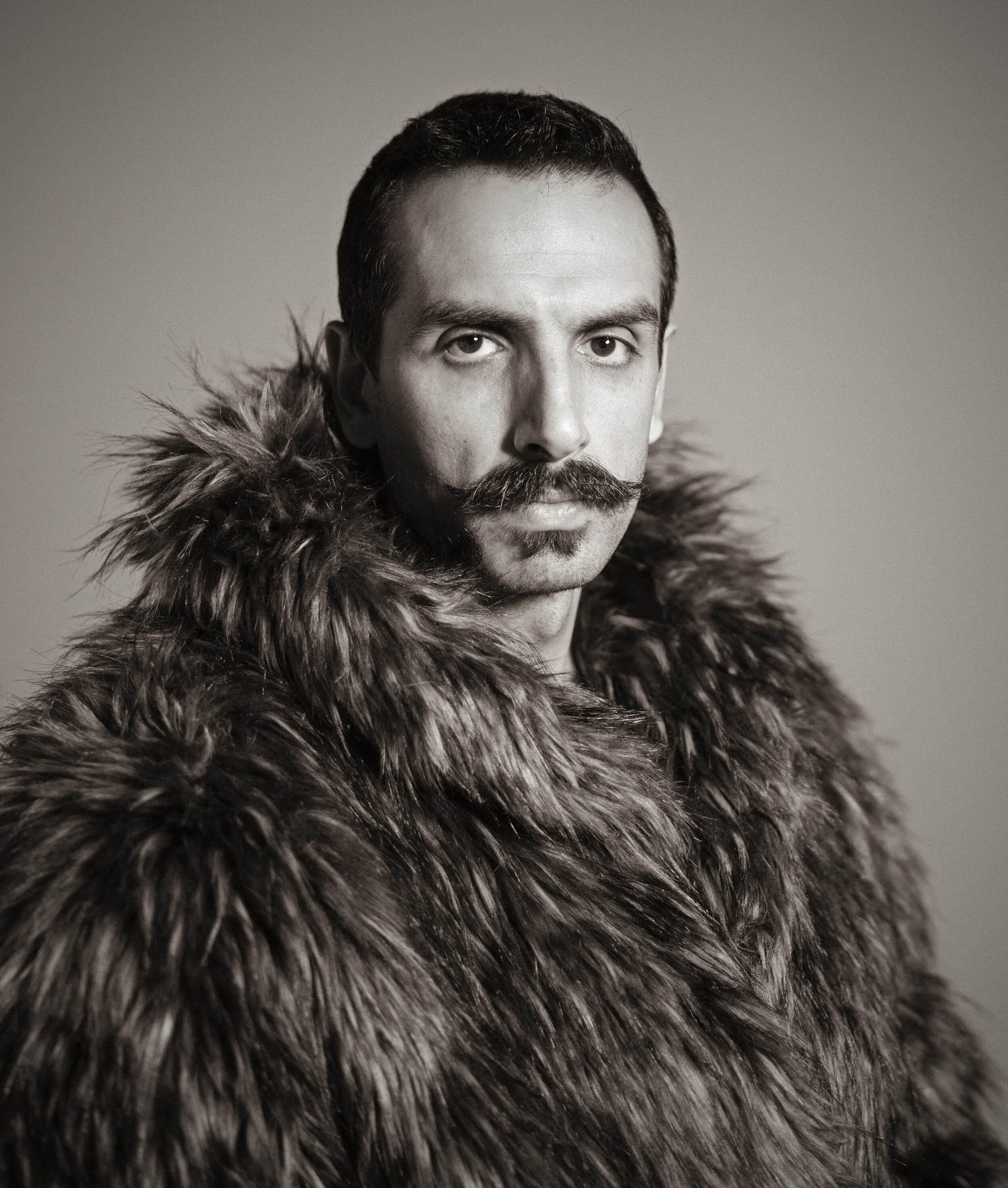
Sayed Sattar Hasan’s Portrett av Hasansen also focuses on self-reinvention as a means of interrogating notions of personal and collective heritage, and the spirit of the joker is also alive in his work. Portrett av Hasansen marries a photographic portrait of Hasan with an iconic 1896 image of the Norwegian explorer and polymath Fridtjov Nansen. This gives birth to “Hasansen”, a charismatic masquerader who seems to partake of the unorthodoxy and daring of both his (male) parents. Hei, Herr Hasansen! Like Courbet, the figure of Hasansen announces a certain disregard for proprieties and hierarchies, but when we look at this work it is not possible to forget the wider historic and social legacies, preconceptions and prejudices against which Hasan pitches his photographic-performative gambit.
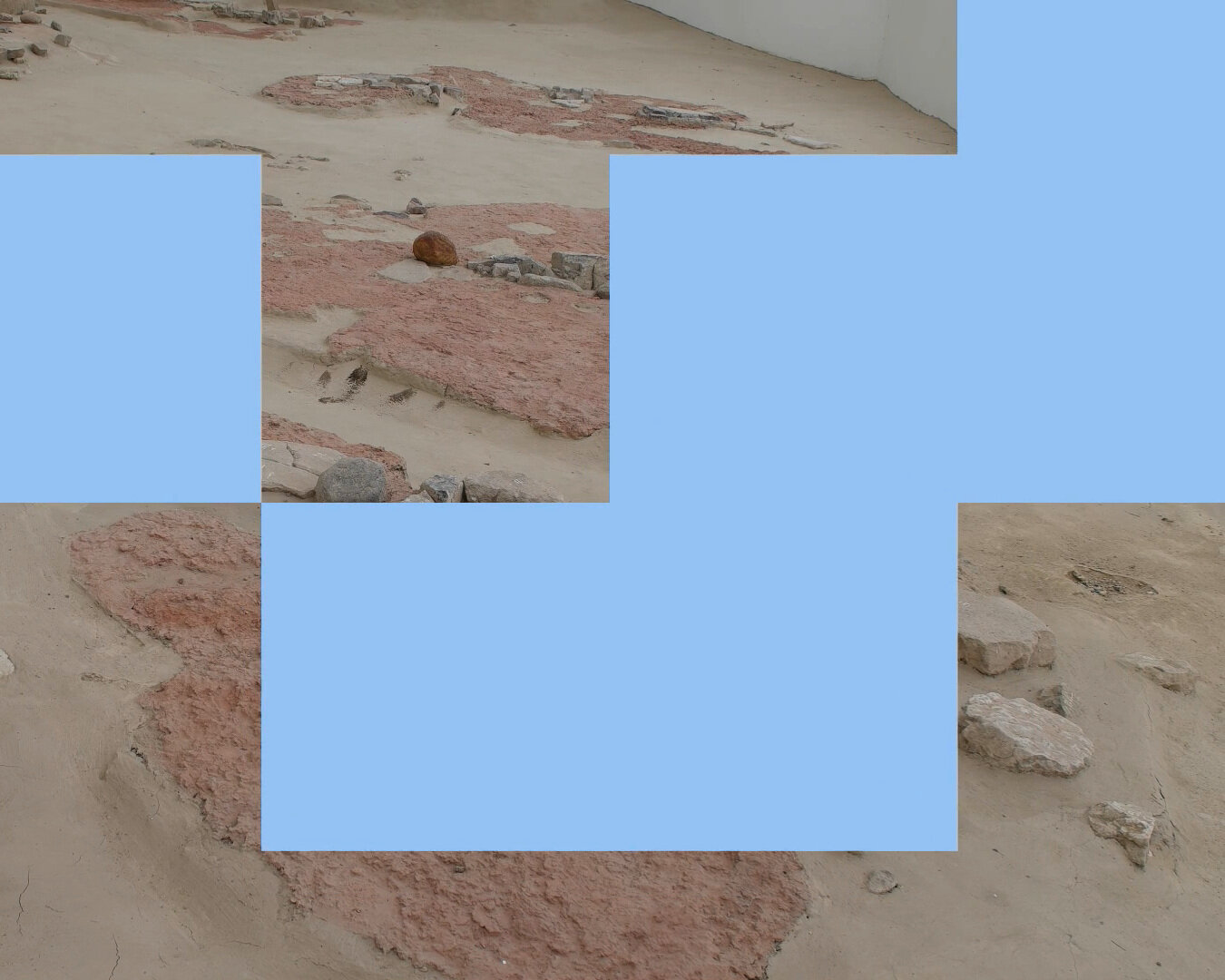
Nina Torp’s Methods of Pattern Making [Lepenski Vir] is a work in progress – a drafted first chapter of a video project that will probe the intellectual and ideological frameworks within which some of the world’s oldest archaeological remains were rediscovered and that continue to shape their contemporary display. As in an archaeological dig, Methods of Pattern Making is stratigraphic. It overlays and filters visual documentation of ancient remains with patterns and forms that meld modern rationalist schemata and modernist aesthetics. However, the goals of Torp’s personal stratigraphy are poetic and critical rather than rationalistic, and designed to activate the viewer’s own questions about the present-day interests and needs that inform contemporary presentations of the deep past.
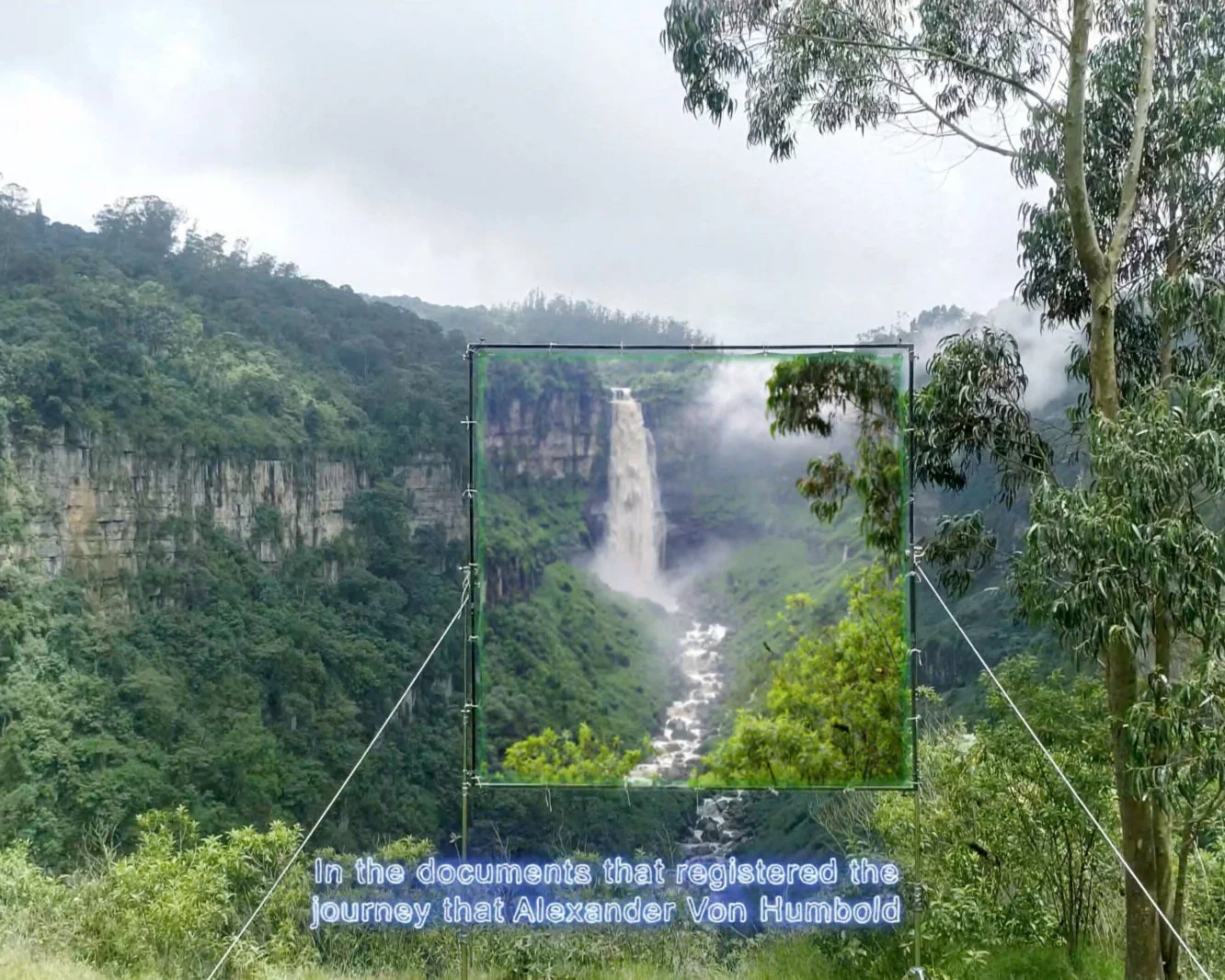
Juan Covelli’s El Salto is also a first instalment of a larger project that he hopes to complete in 2023. It focuses on El Salto, a famous “natural spectacle” to the south-west of Bogotá, and reflects the artist’s concerns with digital colonialism and its impacts on people and the environment, alongside his practices of detailed research into the histories of representation. This multilayered work posits “landscape” not simply as an artistic genre but as a technology of colonial domination, and its response to this is to propose a delegation of the “burden” of representation to non-human agencies. By opening ourselves up to the point of view of machines (algorithms, drones) and subordinating the idea of human agency, it asks, might our species discover better ways of deploying the powerful technologies we have developed, and learning to live within rather than to “master” the global ecology we are presently destroying?
Eliza Naranjo Morse’s Light from Love is a gesture of giving. It consists of a downloadable PDF that can be printed as an unlimited multiple work: a small card bearing an image and a poem, that can be gifted without limit. Optimistic and full of compassion, it shows a collective of animals, each carrying a small cargo or backpack, against a background that reminds us of the wider cosmos we all inhabit. Naranjo Morse sees this work as representative of a worldview that she has been fortunate to inherit from her elders, and hopes that it will evoke reflection and consideration of how the choices we make affect others, now and in the future.
Light from Love is a token of a kind of selfhood that accepts its instabilities, dependencies and vulnerabilities, and that chooses to carry its hard inheritances with purpose and integrity. It’s a nice reminder (nice in the sense of both sympathetic, and exact) of what matters, at a time when we are assailed daily by diverse instances of amnesia, carelessness, selfishness and thoughtless, brutal violence.
Portrett av Hasansen
Sayed Sattar Hasan
El Salto
Juan Covelli

Becoming Kaspale
Syowia Kyambi

Light from Love
Eliza Naranjo Morse

